How to Choose a Web Design Company in Albuquerque, NM (And Not Regret It)

Albuquerque has no shortage of web design companies. Finding a good one is a different problem entirely. Our honest take: the biggest mistake we see is hiring based on portfolio aesthetics alone — a beautiful portfolio and a disciplined process are two very different things.
There are national agencies with slick websites and zero local knowledge. There are freelancers who disappear after launch. There are budget shops that deliver budget results and then blame your expectations. This guide is for the business owner who has been burned before — or wants to avoid it the first time.
What a Web Design Company in Albuquerque Should Actually Know
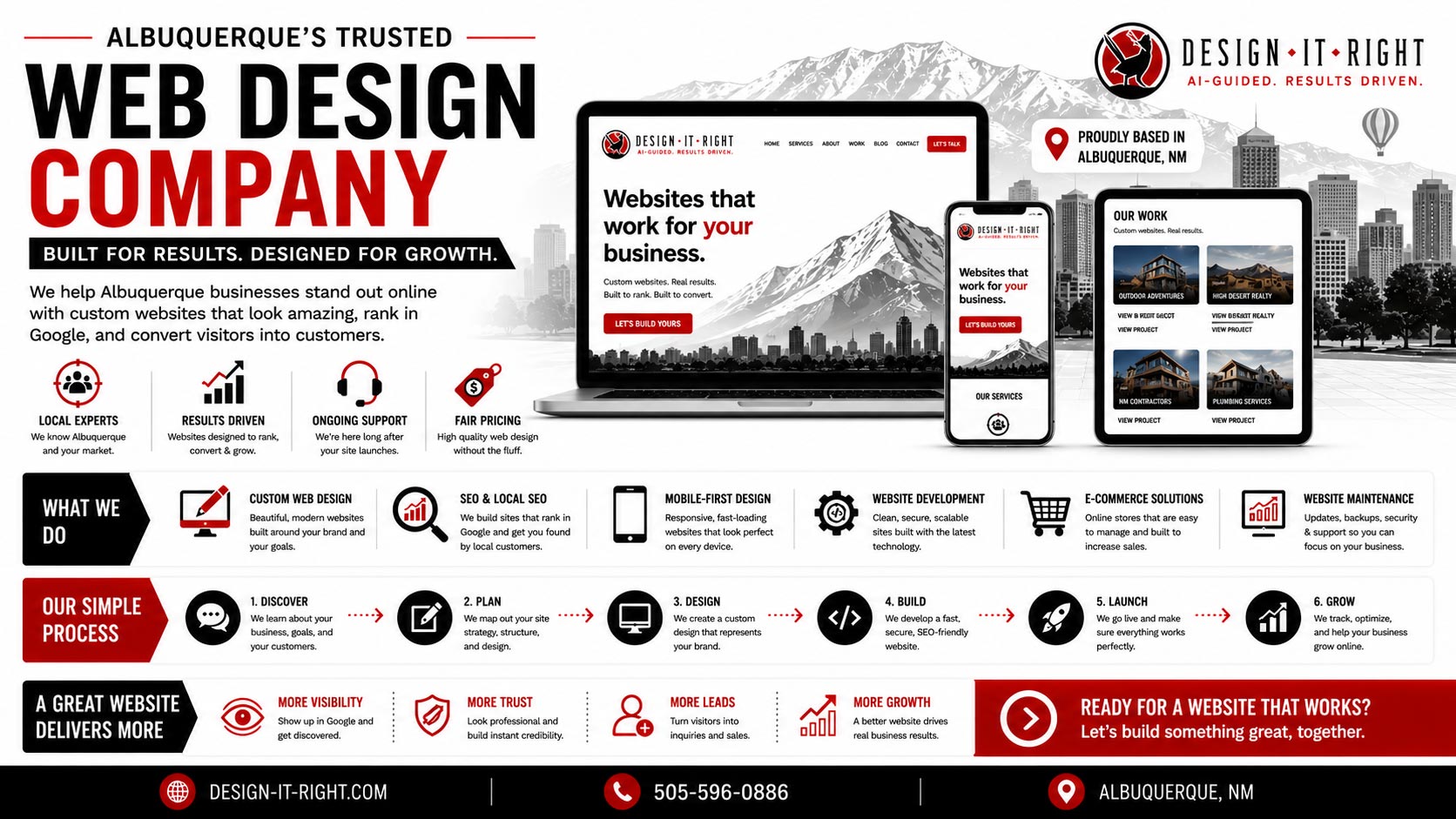
A web design company operating in Albuquerque should know this market the way a local business owner knows it — the neighborhoods, the seasonal patterns, the competitive landscape across different industries, and the specific ways Albuquerque consumers discover and evaluate local businesses. A firm that cannot speak to any of that is building you a website for a generic audience, not for your actual customers.
Beyond market knowledge, a qualified web design company should understand the technical fundamentals that determine whether a site actually performs: Core Web Vitals, mobile-first indexing, local schema markup, and conversion-oriented design principles. Portfolio work is the evidence — look for sites that rank, load fast, and have clear paths to conversion, not just sites that look attractive in screenshots.
Local Market Knowledge vs. Generic Templates
Local knowledge is not a selling point. It is a baseline requirement. A web design company operating in Albuquerque should understand how New Mexico customers search. They should know that the market from Rio Rancho to the East Mountains behaves differently. They should have designed for the industries that actually drive this economy — healthcare, construction, hospitality, trades, and government contracting.
If the agency you are talking to cannot name a client in your industry within 50 miles, that is worth noting. Real local experience produces real local results. National templates dressed up with your logo is not web design — it is decoration.
Industry-Specific Design Experience
Every industry has a different customer journey and a different conversion pattern. A construction company site needs social proof, project galleries, and service area pages. A healthcare practice site needs trust signals, HIPAA-conscious design, and appointment booking. A retail business needs product presentation, local schema, and fast mobile performance. Generic builds fail every one of these requirements because they start with the template, not the customer.
Ask any agency you interview what they know about your specific industry. If the answer is vague, the site will be too.
The Questions That Separate Good Agencies From Great Ones
Most business owners evaluate agencies by portfolio and price. Both matter. Neither is enough. The questions you ask before signing reveal whether an agency is selling confidence or demonstrating competence — and the difference only becomes obvious after the contract is signed.
Ask who specifically will build your site, what their process looks like from kickoff to launch, how they have handled a project that went wrong, and whether you can speak directly to a client in your industry. A great agency answers all of these without hesitation. An average one pivots to showing you more portfolio work.
Most business owners evaluate agencies by portfolio and price. Both matter. Neither is enough. The questions you ask before signing tell you more about an agency than anything on their website.
Questions About Process and Accountability
Here are the questions worth asking before you sign anything. These are not trick questions — a good agency will answer all of them without hesitation.
Who Actually Builds Your Site?
Many agencies sell at the executive level and outsource to offshore developers. You deserve to know who is writing your code, building your pages, and answering your calls when something breaks. At Design It Right, the same team that talks to you builds your site — no handoffs, no surprises.
Ask this directly: who specifically will be my point of contact during the build, and who handles post-launch support? If the answer is vague, keep looking.
What Happens After Launch?
A website is not a one-time project. It needs security updates, plugin maintenance, performance monitoring, and ongoing WordPress maintenance to stay healthy. Ask specifically what post-launch support looks like — and get it in writing before you sign.
Agencies that treat launch as the finish line are building you a liability, not an asset. Every site we deliver comes with a documented handoff and a clear maintenance path.
Can You Show Sites That Actually Rank?
Any agency can build a beautiful website. Fewer can build one that generates leads through organic search. Ask for live URLs, check their Google rankings yourself, and look at the real-world traffic they have delivered for clients in competitive local markets. This is the only portfolio metric that matters for local SEO performance.
If they show you screenshots instead of live URLs, that is a reason to keep looking.
How Do You Handle Mobile and Speed?
According to Google’s Core Web Vitals documentation, page experience signals are a confirmed ranking factor. A site that loads slowly on mobile is not just a bad experience — it is an active SEO liability that suppresses your visibility every single day. Ask what the agency’s specific process is for page speed optimization and mobile-first design. If they do not have a documented process, assume they do not have one. We run performance audits on every site before launch and set measurable TTFB and LCP targets as part of every build contract.
Red Flags to Watch For
The red flags that matter most in evaluating a web design agency are not always obvious. Vague answers about who will actually do the work, pricing that seems too low to be sustainable, pressure to sign quickly, and an unwillingness to provide references from clients you can actually contact are all signals worth taking seriously.
The subtler flags are equally important: an agency that talks mostly about design and rarely about conversion, one that cannot explain how they approach SEO fundamentals, or one whose own website has performance problems. If they cannot execute for themselves, the bar for what they will deliver for you is already visible.
Not every warning sign is obvious. Some of the worst agency experiences start with a great sales call and a polished pitch deck. These are the patterns worth watching for before you commit.
Process Red Flags
Vague timelines. “A few weeks” is not a project timeline. Ask for a specific milestone schedule — kickoff, wireframes, design review, development, QA, launch — before you sign. Any agency that cannot produce this is not running a real process.
No discovery phase. A legitimate agency asks you hard questions about your customers, competitors, goals, and current marketing before quoting a price. If they can price the project without understanding your business, they are selling a template, not a strategy.
Ownership ambiguity. You should own your domain, your hosting account, your WordPress login, and your content — 100%, from day one. Any agency that bundles these into a monthly fee you cannot escape deserves extra scrutiny. We hand over full credentials at launch, every time.
No local portfolio. This is Albuquerque, not Phoenix. Ask to see work done for New Mexico businesses with measurable results, not just screenshots of sites in other markets.
What a Web Design Project in Albuquerque Actually Costs
Pricing varies enormously — and for good reason. A basic 5-page brochure site from a local freelancer might run $800–$2,500. A fully custom WordPress build with SEO architecture, mobile optimization, and content strategy from a qualified agency typically runs $5,000–$15,000 or more. The question is not which number is right — it is what you are getting for each.
A $1,500 site that does not rank, does not load fast, and cannot be updated without a developer is not a bargain. A $7,500 site that generates consistent leads for three years is one of the best investments a small business can make. Evaluate value, not just the line item total.
What Should Be Included in the Quote
- SEO setup — meta titles, schema markup, Google Search Console submission
- Content strategy — who writes it, who optimizes it, and how it maps to your keywords
- Mobile-first optimization baked in, not an add-on
- Post-launch maintenance plan with clear pricing
Why 30 Years of Experience Changes the Equation
Design It Right has been building websites since 1992. That is not a marketing line — it is a track record that spans five different versions of the internet. We have watched businesses waste tens of thousands on sites that ranked nowhere and converted nobody. We have rebuilt the cheap sites more times than we can count, and we have seen what happens when a plugin update breaks a business that had no maintenance plan.
What three decades teaches you is this: the technical work is the easy part. Understanding what a customer in Albuquerque actually searches for — and building a web design that shows up when they do — is the work that moves businesses forward. We have been doing exactly that since before Google existed.
What AI-Integrated Web Design Means for Your Business
The web design landscape changed significantly in 2025. The agencies still building static websites with no automation, no AI-assisted content strategy, and no ongoing intelligence are already falling behind. The businesses that win online in 2026 and beyond are those whose websites work around the clock — not just as a digital brochure, but as an active lead generation and communication system.
Design It Right deploys AI agents — Josh, Axel, and Janet — that monitor site health, track SEO performance, support client communication, and execute tasks that previously required a full marketing team. Our clients do not just get a website. They get an infrastructure that keeps working after we hand it off.
How to Start the Conversation
The best web design relationships start with honesty on both sides. Tell us where you are at — what is working, what is broken, what you have tried before. Tell us who your best customers are and where they come from. Tell us what success looks like 12 months from now.
From there, we will tell you what is realistic — including if there is a better path than a full redesign. That is what 30 years of doing this actually looks like. No hard sell. No templates dressed up as strategy. Just honest work from a team that has been in this business since before Google existed. Start with a free consultation.
Frequently Asked Questions
About the Author: Mike Jennings is one of the founders and lead developer at Design It Right, a national digital marketing agency. With over 30 years of experience building websites and growing businesses online, Mike has worked with clients across New Mexico, Texas, California, and beyond. Questions? Reach him at [email protected].
The agencies that last in this industry are the ones that treat every site as if their own reputation depends on it — because it does. We have been doing that since 1992, and we are not about to stop now.